
Poverty tends to repeat itself across generations, not because families lack ambition, but because access to the tools that build real opportunity is so unevenly distributed. Understanding how STEM education breaks the cycle of poverty starts with a simple, well-documented fact: the wage gap between STEM and non-STEM careers is enormous, and access to STEM learning early in life is one of the clearest predictors of who ends up on which side of that gap.
For a Houston nonprofit like AD-Technical, which brings STEM and technology education to underprivileged children to help close the digital divide, this is the entire premise behind the work. Every child deserves a real shot at the kind of career that lifts a family out of poverty provided the schools already have the funding, the labs, and the trained teachers to make that possible. The research below lays out exactly why that access matters so much, and why closing the gap early in a child’s life carries such long-term weight.
The Wage Gap Is the Starting Point
The economic case for STEM education is not subtle. According to the Bureau of Labor Statistics, STEM occupations had an annual mean wage of $108,330 in 2023, more than $40,000 higher than the U.S. average wage of $65,470 across all occupations, with more than 85 percent of STEM occupations paying above that national average. Separate BLS wage data cited by researchers at the Equity in Higher Education project puts the median STEM wage at $101,650, compared with $46,680 for non-STEM work, more than double.
That gap holds up even for workers without a four-year degree. Among people with some college education, a typical full-time STEM worker earns $54,745, compared with $40,505 for a similarly educated non-STEM worker, a 26 percent difference reported by CodeWizardsHQ. And the field is growing, not shrinking. The BLS projects STEM employment will increase at nearly three times the rate of non-STEM employment between 2023 and 2033, meaning the opportunity is expanding right as automation reshapes lower-wage work elsewhere in the economy.
Access, Not Ability, Is the Real Barrier
If the financial case for STEM careers is this strong, the obvious question is why more low-income students don’t end up in them. The research points overwhelmingly to access, not ability. A Development Southern Africa study found that STEM education has been proven effective in reducing poverty and enabling upward socioeconomic mobility by providing access to higher-paying jobs, but that many people living in poverty, particularly in rural and underserved areas, lack the knowledge and opportunities to enter STEM fields in the first place, not the aptitude for them.
A separate guide on poverty and STEM education prepared for schools in Wales makes the same point from inside the classroom. The guide, via Children in Wales, cites substantial research evidencing the link between socioeconomic status and educational outcomes, with children from poorer backgrounds achieving lower grades and fewer qualifications than more privileged peers, a gap that extends specifically into science and STEM subjects throughout school. The guide also notes that while higher education broadly drives social mobility, STEM subjects show considerable variation in accessibility for disadvantaged students compared with other fields, meaning the very subjects with the biggest wage payoff are often the hardest for low-income students to access.
The Research on Mobility Backs This Up
Some of the most rigorous economic research on this question comes out of Opportunity Insights, a research and policy institute based at Harvard University led by economist Raj Chetty. Their work has found that increasing the representation of low- and middle-income students at selective colleges could substantially increase intergenerational income mobility in the United States. Their landmark study on income segregation across American colleges, published in the Quarterly Journal of Economics, matched federal tax records for millions of students to their parents’ income and tracked their earnings for more than a decade, giving researchers, for the first time, a direct measure of which institutions and pathways actually move students up the income ladder rather than just measuring enrollment numbers.
The throughline across all of this research on how STEM education breaks the cycle of poverty is consistent: education alone isn’t the full answer. The specific kind of education matters enormously, and STEM fields, with their outsized wage premiums and fast-growing job market, are one of the most direct and well-documented pathways from low income to real economic stability.
This distinction matters because it reframes the conversation away from a vague call to “value education more” and toward something far more actionable. Families and communities don’t need to guess at what kind of learning moves the needle most. The wage data and mobility research both point in the same specific direction, toward STEM.
Why Early Exposure Matters So Much
The access gap doesn’t start in college or even high school. It starts early, and it compounds. Research reviewed by a study on STEM education’s role in addressing poverty, published via ResearchGate, highlights the importance of visual arts-integrated STEM education specifically in early childhood, pointing to decades of published research on how foundational exposure to science and technology concepts before formal schooling shapes a child’s trajectory toward, or away from, these fields entirely.
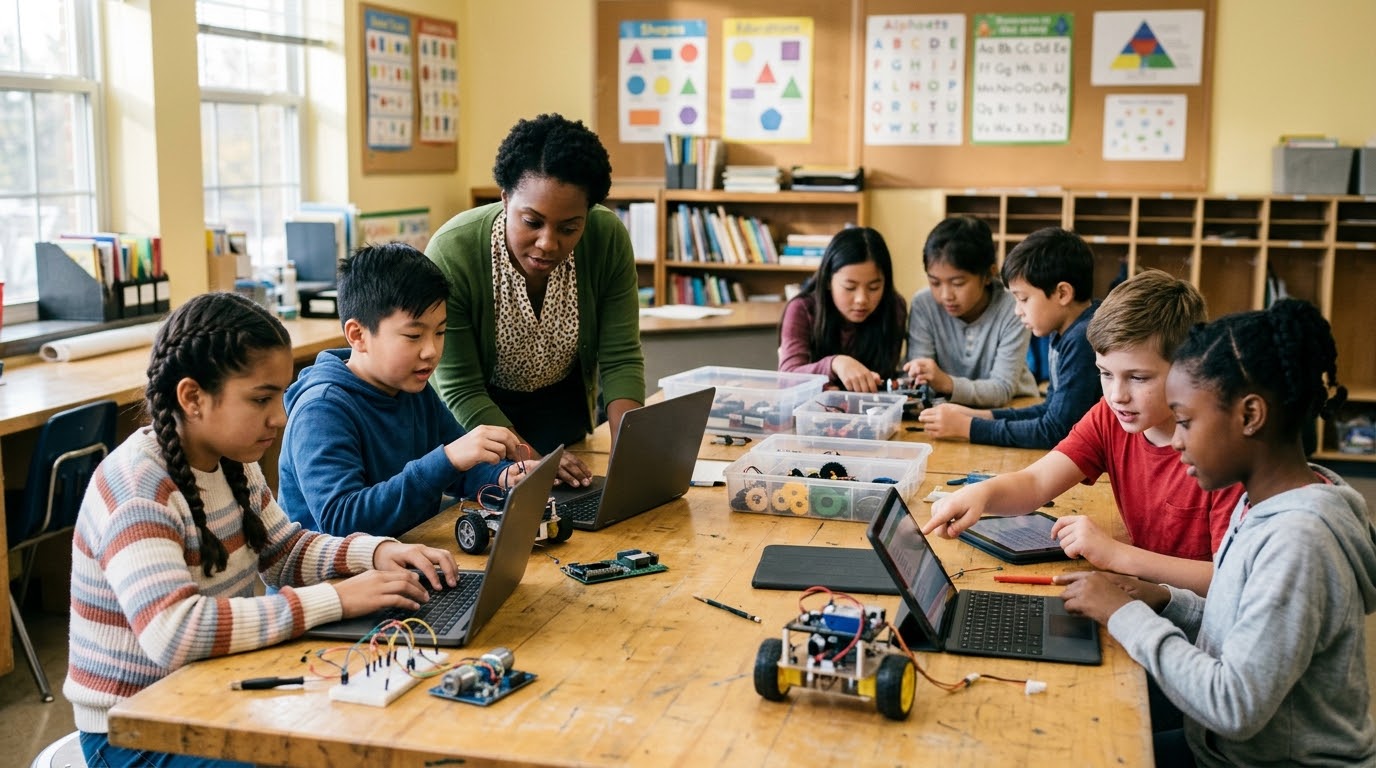
This matters because STEM confidence, much like literacy, tends to be built cumulatively. A child who never gets hands-on exposure to coding, robotics, or basic engineering concepts before high school is starting years behind a peer who had that exposure in elementary or middle school, regardless of natural aptitude. By the time college major or career decisions arrive, that early gap has often hardened into a real barrier, not because the student couldn’t succeed in STEM, but because they never had the early foundation or confidence to consider it a realistic path in the first place.
The compounding nature of this gap is what makes early intervention so valuable. A single STEM class in eleventh grade can spark real interest, but it rarely closes years of missed foundational exposure. Programs that reach children in elementary and middle school, well before high school course selection even becomes a factor, have a much better chance of keeping STEM pathways genuinely open rather than trying to catch students up after the gap has already widened.
Where AD-Technical Fits Into This Picture
This is exactly the gap AD-Technical’s STEM programs exist to close. The organization’s own mission statement puts it plainly: to bridge income inequality using STEM education requires a collective effort of parents, educators, community leaders, and anyone who cares about the next generation’s future to be part of the work.
Understanding how STEM education breaks the cycle of poverty means recognizing that the wage data, the access research, and the mobility studies all point toward the same conclusion. A child who gets real, early exposure to STEM learning, regardless of their family’s income or their neighborhood’s school funding, has a genuinely better shot at a career that changes their family’s financial trajectory. That opportunity shouldn’t be reserved for children whose families can already afford private coding camps or well-resourced school districts.
The Bigger Picture
None of this means STEM education is a silver bullet that erases poverty on its own. Housing costs, healthcare access, and dozens of other factors all shape a family’s economic reality. But among the levers available to community organizations, schools, churches, mosques, libraries and individual families, few are as well documented or as directly tied to earning potential as access to STEM learning. The wage data from BLS, the access research from South Africa and Wales, and the mobility studies from Opportunity Insights all point in the same direction: how STEM education breaks the cycle of poverty isn’t a theory, it’s a pattern researchers keep finding across different countries, different student populations, and different points in a child’s life.
For families living this reality every day, that pattern translates into something concrete: a child who gets consistent, early access to STEM learning is a child with a genuinely wider set of career options by the time they’re old enough to choose one. That widened set of options is, in the end, what breaking a cycle actually looks like in practice, not a single dramatic turning point, but years of accumulated access finally opening a door that would otherwise have stayed closed.
If you want to help make that same kind of STEM learning available to underprivileged children in Houston, you can get involved here.